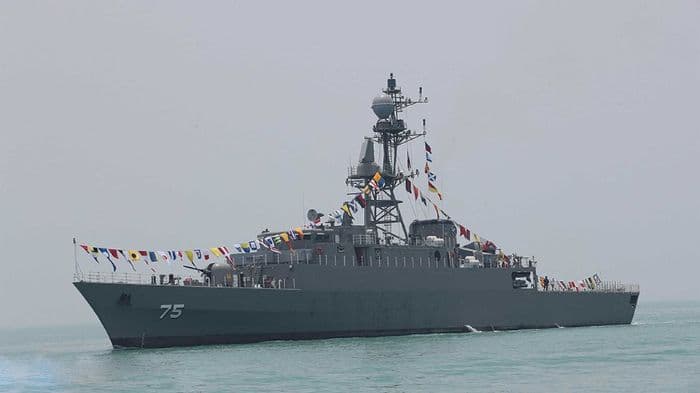
You know, it’s one of those stories that makes the vastness of the Indian Ocean feel suddenly, chillingly small. We usually think of these big naval maneuvers as posturing—steel giants playing a high-stakes game of chess where nobody actually moves a piece. But what happened on March 4, 2026, off the coast of Galle, Sri Lanka, wasn’t a game. It was a brutal, clinical strike that turned a peaceful return voyage into a mass grave in less than three minutes. We’re talking about the sinking of the IRIS Dena, an Iranian Moudge-class frigate, by the American nuclear-powered submarine USS Charlotte. If you’re looking for a moment where the shadow of the Middle East conflict officially stretched its fingers all the way into the Indian Ocean, this is it.
Imagine the scene just a week before. The Dena was in Visakhapatnam, India, for the MILAN 2026 naval exercises. It wasn't there as an aggressor; it was an invited guest. There were photos of the ship decked out in ceremonial flags, the crew standing tall on the deck, even the Iranian Navy band playing music. They were part of a multinational gathering meant to foster cooperation. When the exercise wrapped up, the Dena began its long trek back home to the Persian Gulf, sailing alongside its support vessel, the IRIS Bushehr. They were in international waters, about 19 to 20 nautical miles -6.0073°N 79.8654°E- off the southern tip of Sri Lanka—a beautiful, calm stretch of sea often filled with whale-watching boats and cargo ships. The sailors probably thought they were safe. They’d just spent weeks shaking hands with sailors from all over the world. But while they were steaming through those deep blue waters, the USS Charlotte, a Los Angeles-class attack submarine, was already there, lurking hundreds of feet below the surface, silent and invisible.
Coordinates of the Sinking Location: 6.0073°N 79.8654°E
The attack happened in the pre-dawn darkness, around 5:00 AM. There was no warning. No "identify yourself," no "change course," just the cold mechanical logic of a Mark 48 ADCAP torpedo. When that thing hits a ship like the Dena, it doesn't just poke a hole; it’s designed to explode under the hull, creating a massive air bubble that snaps the ship's spine. Reports say the Dena went down in roughly two to three minutes. Think about that for a second. One moment you’re a sailor on the night watch, maybe thinking about seeing your family in a few weeks, and the next, the world is tilted 45 degrees, the lights are out, and thousands of tons of seawater are screaming into the corridors. Out of the 180 souls on board, only 32 made it out alive.
The sheer speed of it is what haunts the rescue teams. When the Sri Lankan Navy received the distress call at 5:08 AM, they scrambled everything they had. By the time the first rescue boats and a Sri Lankan Air Force plane reached the coordinates, there was no ship left—just a massive, shimmering oil slick and the debris of a life interrupted. They found 32 survivors clinging to whatever they could find in the dark, water-clogged and traumatized. But as the sun came up, the true scale of the horror became clear. They started pulling bodies from the water—87 of them in total. Many were members of that same Navy band that had been playing music in India just days earlier. Instead of returning home with stories of their travels, they were being zipped into body bags on the docks of Galle.
The human cost here is staggering and, frankly, heart-wrenching. We're talking about more than 80 families in Iran who are now mourning fathers, brothers, and husbands. There’s a story floating around about one young sailor who managed to call his father just hours before the strike, mentioning that they had seen American assets in the distance but felt they had nothing to fear because they were on a diplomatic mission. Now, that father is one of many waiting at the airport in Tehran for a coffin to come home via a chartered flight through Armenia. It’s hard not to feel a sense of profound injustice when you realize these men weren't in a combat zone. They were heading home from a party they were invited to.
And then you have the IRIS Bushehr, the auxiliary ship. It was nearby when the Dena was hit, and the panic must have been absolute. Imagine being on a slow-moving support ship and watching your escort—a modern, armed frigate—simply vanish beneath the waves in minutes. The Bushehr eventually limped into Sri Lankan waters, its crew reportedly in a state of total collapse. Some reports say the crew actually abandoned the ship once they reached safety, so shaken by the "quiet death" they had just witnessed. Sri Lankan authorities ended up taking control of the Bushehr at the Welisara naval base, trying to figure out the diplomatic nightmare they’d just inherited.
The geopolitical fallout is where things get really messy. The U.S. Secretary of Defense, Pete Hegseth, didn't exactly strike a somber tone when he confirmed the sinking. He called the Dena a "prize ship" and described its end as a "quiet death." That kind of language has rubbed a lot of people the wrong way, especially in the region. Critics are pointing out that the U.S. chose to sink this ship not because it was an immediate threat, but because it was a target of opportunity. By hitting the Dena so far from the Persian Gulf, the U.S. sent a message that no Iranian asset is safe anywhere in the world’s oceans. But at what cost?
India, for its part, has been in a really awkward spot. The Dena was their guest. For a ship to be welcomed into an Indian port with honors and then be torpedoed just a few miles down the road by India's major strategic partner, the U.S., looks terrible. It undermines the idea of the Indian Ocean being a "zone of peace" or India being a "net security provider." If you can’t guarantee the safety of the guests you invite to your own naval exercises, what does that say about your control over your own backyard?
Meanwhile, Sri Lanka, a country already dealing with so much, found itself the unwilling stage for this tragedy. The Galle National Hospital and the Karapitiya Teaching Hospital were suddenly filled with wounded Iranian sailors who didn't speak the language and were in total shock. The local community in Galle saw the bodies being brought ashore—the young men in their uniforms, now lifeless. There’s a lot of quiet criticism of the U.S. submarine’s actions there; even among people who aren't fans of the Iranian government, there is a universal respect for the "law of the sea," which usually dictates that you don't slaughter a ship's crew in international waters when they aren't actively engaged in hostilities.
The tragedy leaves behind a wake of unanswered questions and a lot of broken lives. While the politicians in Washington and Tehran trade threats, the reality is 150 missing or dead sailors and a hundred more broken families. It’s a stark reminder that in these grand "strategic" moves, the people on the deck are the ones who pay the ultimate price. The Dena was a ship of 180 people, many of them probably just excited to be seeing the world, now resting at the bottom of the Indian Ocean, a casualty of a war they weren't even fighting at the time.